
Does This Outfit Match? How to Tell Before You Leave
Asking does this outfit match is a judgment you can run in a minute: the 60-30-10 color split, neutrals as glue, formality first, and a photo check.
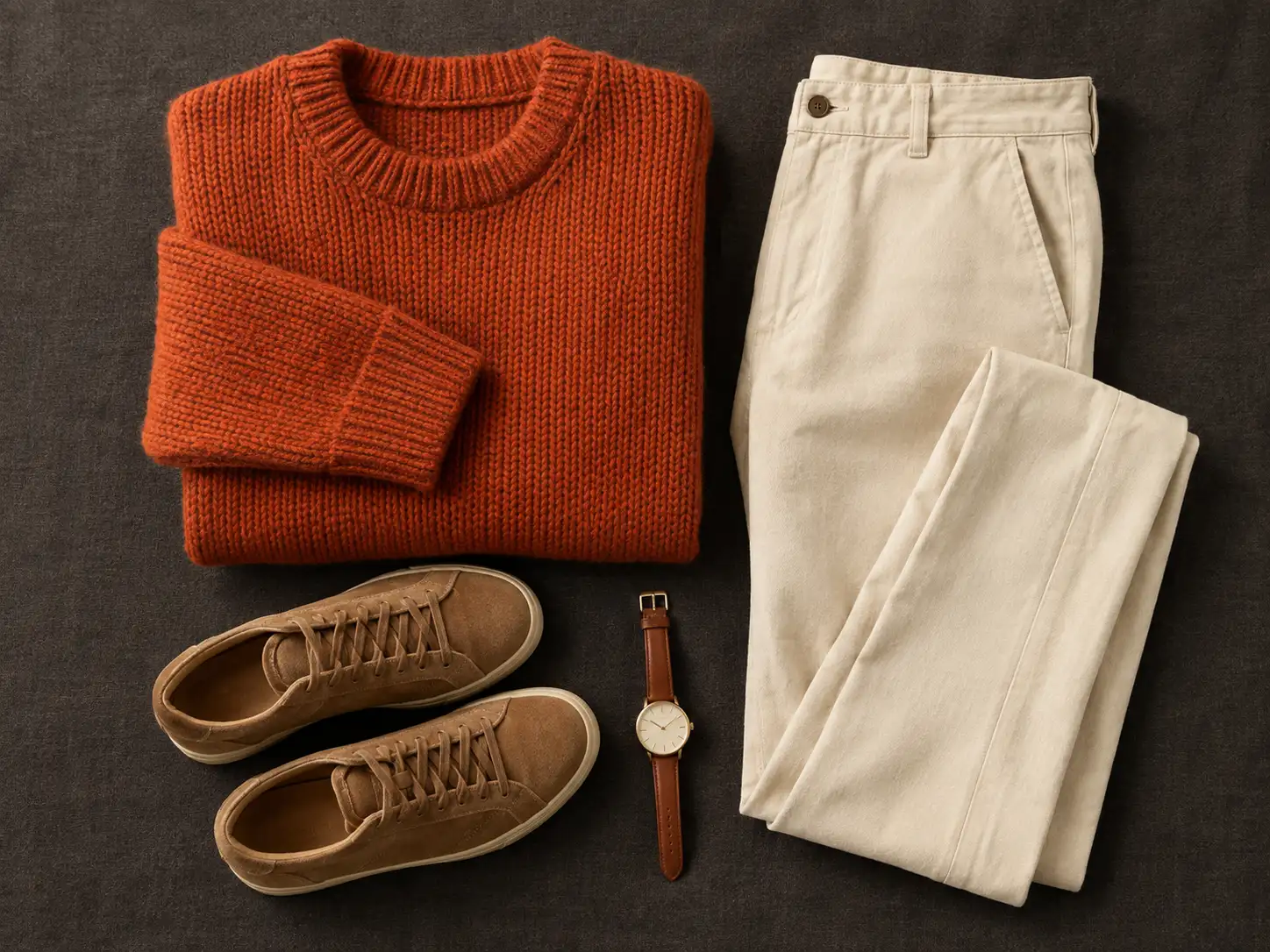
Everyone asks it at some point, usually with one leg in a pair of trousers: does this outfit match? The question feels like a matter of taste, which is why the answers online are so vague. In practice it is closer to a checklist. Outfits read as "matching" when four things agree: color, formality, texture, and proportion. When an outfit looks off, one of those four disagrees, and you can usually find the culprit in about a minute.
This guide gives you the rules with numbers, a checklist you can run before you leave, and the three fixes that rescue a combination that fails. It ends with the step most advice skips: putting the corrected combo on a photo of yourself so you can judge it the way strangers will.
Matching means coordinating, not copying
The biggest misconception baked into the question is that pieces must be the same color, or come from the same family, to work. They do not. A rust sweater "matches" blue jeans even though rust and blue share nothing on a color wheel, because the combination agrees on the layers that matter more:
- Color: the shades relate through undertone and balance, not identity.
- Formality: every piece sits at roughly the same level of dressiness.
- Texture: matte and sheen alternate instead of stacking flat on flat.
- Proportion: loose on top pairs with slimmer on the bottom, or the reverse.
Two pieces can be wildly different and still pass all four. Two pieces can be nearly identical in color and still clash because one is gym-casual and the other is office-formal. That is why "does the color match" is the wrong first question, and formality is usually the better one.
Run the 60-30-10 split
Designers borrow a color split from interior design: roughly 60 percent of the outfit in a dominant color, 30 percent in a secondary, 10 percent as an accent. It is a convention, not physics, but it explains why some combinations feel calm and others feel noisy.
Put numbers on your outfit. Trousers and a knit in the same shade are your 60. The shirt or jacket is the 30. Shoes, belt, watch strap, or a scarf make up the 10. The exact percentages do not matter; what matters is that one color clearly leads, one supports, and the smallest share is the one you are having fun with.
The failure mode is easy to spot once you have words for it: two colors splitting the outfit about 50-50 with no accent at all. Nothing is wrong with either piece, but nothing leads. Move one of them to shoes or a bag and the same two colors suddenly read as a decision instead of an accident.
Neutrals are the glue
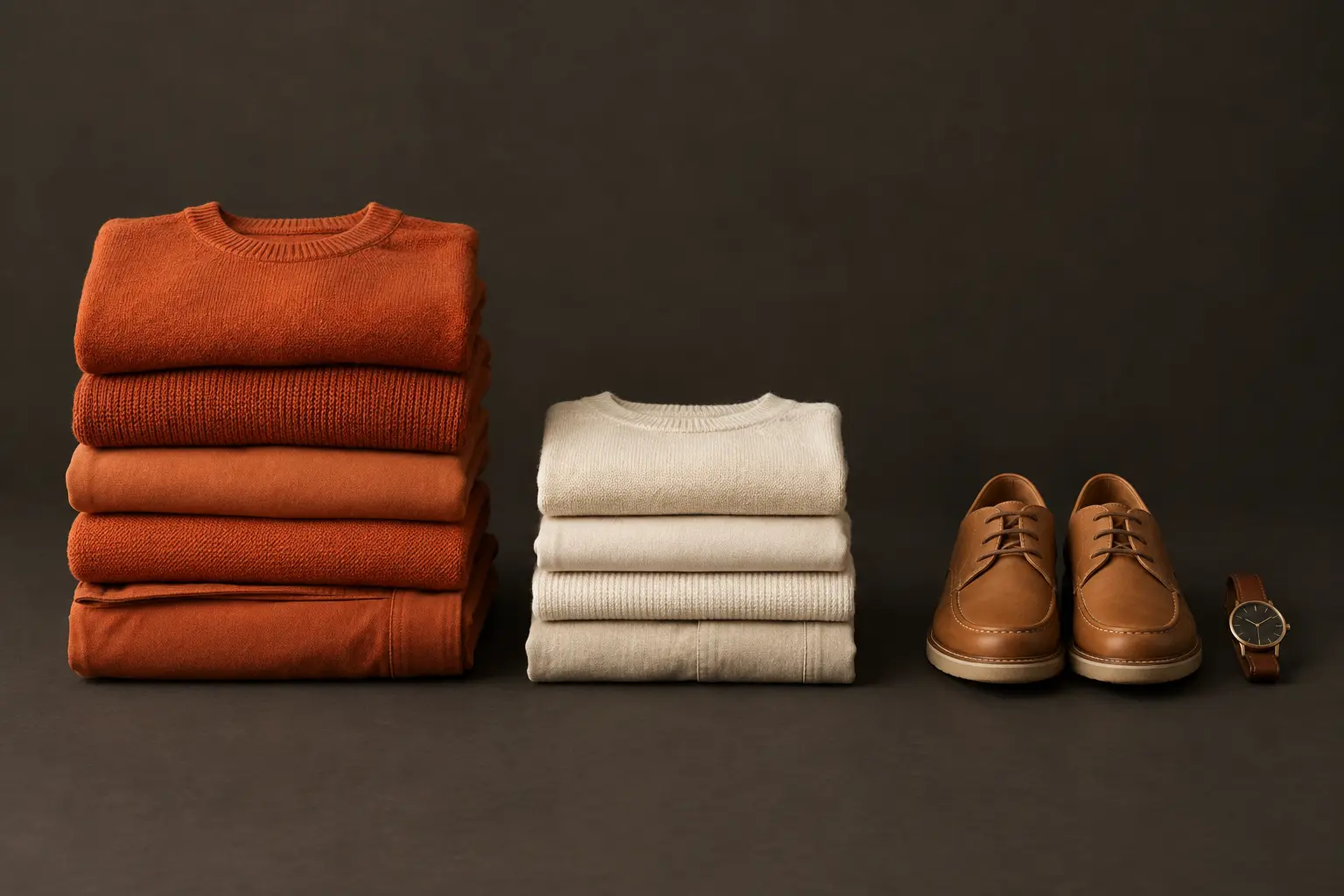
Every wardrobe leans on a short list of neutrals: white, black, gray, navy, beige and brown, olive. They are not exciting, and that is the point. A neutral next to a colored piece lowers the risk of the combination to nearly zero, which is why one-interesting-piece outfits are the reliable default: a green jacket, gray trousers, white shoes. The green gets to be the whole personality, and nothing competes with it.
Two colored pieces can absolutely work together, but they need something in common, and the usual common ground is undertone. Warm colors (rust, olive, cream, brown) sit together comfortably. Cool colors (blue, gray, black, white) do the same. The strained combinations usually pair a warm piece with a cool one at similar volume, like a salmon shirt with cobalt trousers. One of them becomes the 30 percent and the other drops to an accent, or a neutral steps in between them.
The all-neutral outfit is the extreme version of this logic, and it is why a head-to-toe beige or all-black look reads as deliberate rather than lazy: when color stops doing any work, texture and fit carry the whole outfit, so those combinations only succeed when the pieces are cut well and the fabrics differ. A gray tee and gray trousers in the same flat cotton is a uniform; a heavier knit over lighter cotton in close shades is a look.
Let formality lead, texture follow
Color gets the attention, but formality mismatches are what actually make an outfit look wrong from across the room. Canvas sneakers with tailored trousers, a workout tee under a blazer, evening heels with a beach dress: each of these reads as a mistake even when every color is harmonious. Before color, check that all the pieces sit within one step of each other on the dressiness ladder, and let the shoes be the tiebreaker, because that is where eyes go first.
Texture is the quiet half of the same idea. Contrast is useful: rough against smooth, matte against sheen. Denim with a fine knit, wool trousers with a cotton shirt, leather shoes with almost anything. When both pieces have the same texture and similar color, the outfit flattens out and reads as one shapeless mass. When everything is loud at once (gloss, distress, sheen, print), it reads as a costume. Aim for one strong texture and let the rest support it.
The one-minute checklist
Run these six checks in order. They take about a minute and they catch almost everything.
- Name the colors out loud. If you cannot name three or fewer color families, remove one piece. Denim counts as a neutral, not a color.
- Assign the shares. One color leads, one supports, one accents. If two colors split the outfit evenly, demote one to shoes or a bag.
- Check undertones. Warm sits with warm, cool with cool. If a warm and a cool piece are both at high volume, one of them is the problem.
- Match formality. All pieces within one step, and let the shoes set the floor; eyes land there first.
- Count the loud pieces. One statement element per outfit: a print, a bold color, a heavy texture. Two statements compete; three make noise.
- Squint at the mirror. Blur your eyes. One area should dominate. If your attention bounces between two equally bright zones, the balance is off even when every individual piece is fine.
If the outfit passes all six, it matches. Not in the sense that the colors are related, in the sense that a stranger will read it as one deliberate choice.
When it does not match, fix one thing
A failed check rarely means starting over. Run the fixes cheapest-first: restyle costs nothing, a bridge piece is usually already on your shelf, and the swap is the last resort. Three fixes cover most cases:
- Swap the loudest piece for a neutral. The combination usually fails on one garment, not on the idea. Replace it and keep the rest.
- Bridge with a third piece. A jacket, shoes, or a hat in a color that both existing pieces relate to makes two strangers into a set. This is the fastest repair when you cannot change the main pieces.
- Restyle instead of replacing. Tuck the shirt, roll the sleeves, change the shoes, drop the accessory. Proportion fixes cost nothing and often beat shopping for something new.
Fix one thing, then run the checklist again. Two changes at once make it hard to tell what actually improved the outfit.
See the combo on yourself before you wear it
Mirrors are a bad judge at the worst moment: the lighting is your bathroom, your judgment is rushed, and you have been wearing the same silhouette for years. A photo is more honest, and you do not need to own the clothes yet to take one. Describe the pieces to the AI outfit generator, keep your face and pose in the shot, and look at the combination on a body like yours under even light. What felt risky in the closet often reads fine on the photo, and the reverse happens too, which is exactly why the check is worth thirty seconds.

When one piece is the problem and you already own the rest, the AI clothes changer swaps that single garment from a reference photo so you can compare two versions of the same look instead of imagining the difference. And if you are deciding whether to buy the piece at all, the virtual try on vs AI clothes changer comparison explains which tool fits which decision.
The point of all three is the same: judgment gets easier when the combination is in front of you instead of in your head.
FAQ
Does matching mean the colors have to be the same?
No. Matching means the pieces agree on color balance, formality, texture, and proportion. Identical colors are one way to agree, but navy with rust, or olive with cream, match just as well while looking more considered. If you are asking does this outfit match and everything is the same color, you have skipped the harder checks.
How many colors can one outfit have?
Three color families is the comfortable ceiling, with denim counting as a neutral. More is possible with experience, but past three, one of two things tends to happen: the colors fight for attention, or the outfit reads as a costume. The 60-30-10 split exists precisely to keep three colors in a pecking order instead of a brawl.
Does black go with navy?
Yes, with texture separating them. The old rule against it existed because the two shades sit close enough to look like an accident under poor light. A knit texture, a leather shoe, or a mid-tone shirt between them makes the choice visible. Matte black flat against matte navy is the one version that still looks like a mistake.
Can I mix patterns?
Keep two rules. The patterns must share at least one color, and their scales must differ: a wide stripe with a small check works, two medium prints fight. If you are new to it, let one pattern be the 10 percent, in a scarf or socks, and keep the rest solid. That version fails gracefully.
Do the shoes have to match the belt?
Leather should match leather: brown with brown, black with black. Beyond that, shoes and belt do not need to match each other so much as both need to match the formality of the outfit. White sneakers with a brown belt and a tailored trouser is a normal, current combination; the belt is doing trouser-holding duty, not decoration.
What is the fastest way to check an outfit?
Squint at a full-length photo of yourself, not a mirror. If one area dominates, the formality agrees, and you can name the three colors, it matches. If squinting makes your attention bounce between two bright zones, demote one of them to an accent and look again. And when the pieces are expensive or the occasion matters, run the combination through the AI outfit generator first; the photo version of the outfit is more honest than the mirror version, and it costs less than the wrong purchase.